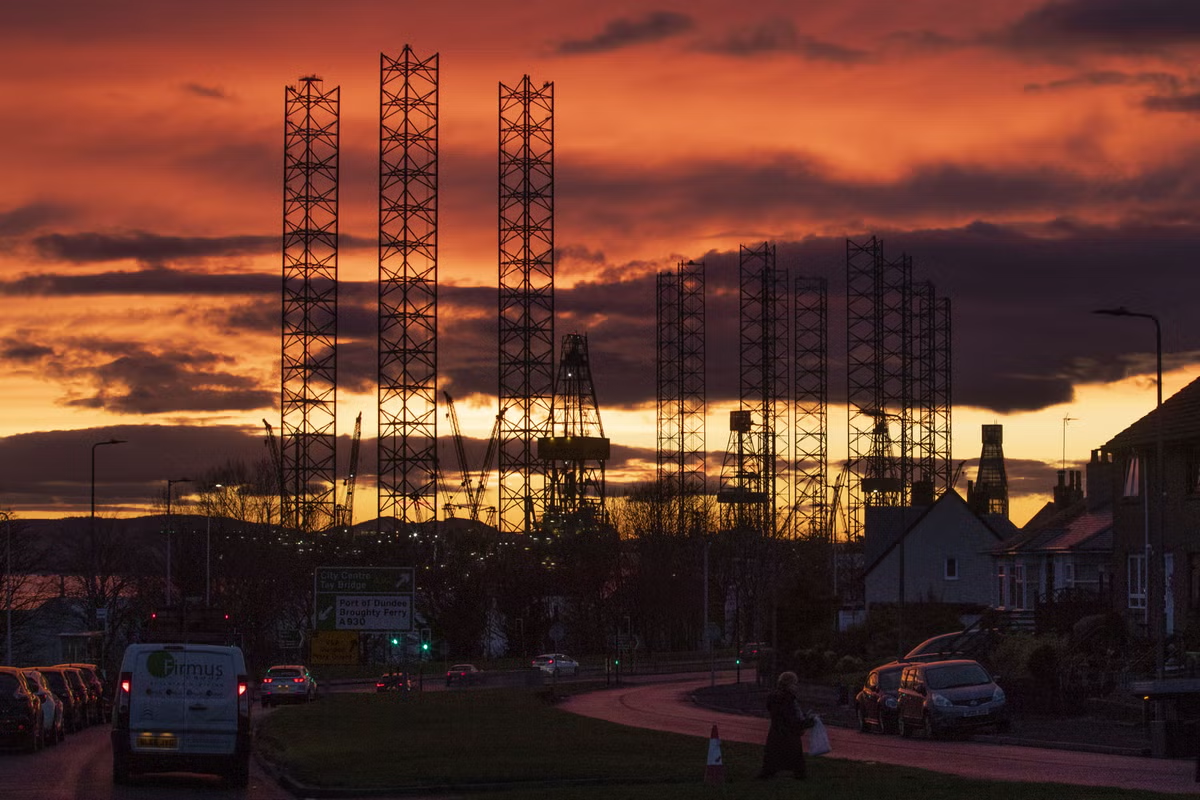
Energy experts have urged the UK government to approve a major North Sea gas field as uncertainty over energy supplies continues amid the crisis in the Middle East.
Reports suggested Energy Secretary Ed Miliband is willing to approve the Jackdaw project, but the Government says the speculation is “incorrect”.
A decision is still awaited on the project, which was halted by a Supreme Court ruling in 2024 which stated that emissions created by burning fossil fuels should be considered when granting planning permission for new drilling sites.
A challenge brought by environmental campaigners following the Supreme Court's ruling, over the approval of the Rosebank oil field northwest of Shetland and the Jackdaw gas field off Aberdeen, was upheld at the High Court in Edinburgh in January last year.
The projects were able to reapply for authorization after the Government published new environmental guidelines last summer, and the Jackdaw project is currently being assessed by the Offshore Petroleum Regulator for Environment and Decommissioning (Opred) after more information has been submitted.
Opred is understood to have requested more details.
The Department of Energy Security and Net Zero posted a statement online saying: “The current speculation is wrong. No decisions have been made about Jackdaw; it is incorrect to suggest otherwise.
“The developers have confirmed that the process is ongoing and the independent regulator has recently requested more information before a final decision can be made.”
Previously, a source close to the Secretary of Energy said that it is not true that he has a particular opinion on the decision, since he does not currently have complete information.
Information submitted on behalf of the project said that at peak production Jackdaw is expected to contribute around 6.5% of UK continental shelf gas production, which would produce enough energy to heat more than 1.4 million homes.
Lord John Browne, former BP chief executive, said the Jackdaw field should “absolutely” be approved.
He told BBC Radio 4's Today programme: “We need all forms of energy and we need to make sure we have a diversified source. We don't have enough diversification today to deal with crises in the future.
“On the North Sea issue, there are a couple of fields that are partially developed. They should be fully developed and move forward.”
Asked whether Jackdaw and Rosebank should be given the green light immediately, he said: “Absolutely, because they are investments that have been partially made. And I think stopping investments mid-stream is not a good sign for the market to have confidence in the investment environment in a country.”
Offshore Energies UK (OEUK), trade association for the UK offshore energy industry, welcomed the commitment earlier this month by the UK Government and key partners to stabilize energy markets and increase production in certain producing nations amid the crisis in the Middle East.
OEUK energy policy director Enrique Cornejo said: “As Europe's second largest oil and gas producer, this should include the UK playing its part in boosting energy supply, introducing the Oil and Gas Price Mechanism to increase investment, approving key projects such as Jackdaw and Rosebank, and continuing to expand offshore wind production.”
David Whitehouse, chief executive of Offshore Energies UK, said: “This is neither a renewables nor an oil and gas scenario.
“We urgently need increased supplies of secure domestically produced energy, including oil and gas, which will remain a vital part of the UK energy system and economy for decades.”
A UK Government spokesperson said: “We cannot comment on live planning decisions, and these decisions will be made in an appropriate and timely manner, after the last government's plans were found to be unlawful.”
North of the border, Scotland's First Minister has softened his Government's position on domestic oil and gas extraction as energy prices soar amid the crisis in the Middle East.
SNP-led governments in recent years have been cautious about further drilling in the North Sea, despite pressure from industry and opposition parties.
However, speaking in a live recording of the Holyrood Sources podcast on Thursday, John Swinney appeared to change his stance following the Strait of Hormuz blockade.
He said: “I can't give you a definitive answer on Jackdaw and Rosebank, because the climate compatibility assessment needs to be done…
“What I'm telling you is that I think we have to look at the geopolitical situation that we face now and recognize that we are experiencing a much greater risk to our energy security as a consequence of what is happening there.”
Speaking in Edinburgh, Scottish Liberal Democrat leader Alex Cole-Hamilton said: “We must always keep in mind our obligations to the climate emergency.
“But if you're making an assessment of the oil and gas we still need in Scotland, I think it makes more sense to extract it from the North Sea, which doesn't have the extra emissions of importing it from other countries.”
Patrick Harvie, Scottish Greens candidate for Glasgow, said: “Scotland has a huge wealth of clean, cheap, green and renewable energy sources on our doorstep.
“We don’t need to drain the North Sea of fossil fuels or continue pumping climate-destroying pollution into the atmosphere.”
Scottish Labor leader Anas Sarwar said a “balanced approach” is needed on the energy issue.
He told the Press Association: “We have to show in this country that you can have more jobs, more construction, great energy security and meet our climate change obligations at the same time.
“That means taking a balanced approach. It means supporting oil and gas, which has a role to play in the coming decades, it means investing in our great country's huge renewable energy potential, but it also means ending the ideological blockade on clean nuclear energy that currently exists in Scotland to unlock billions of pounds of investment, thousands of new jobs and greater energy security.”
Philip Evans, chief climate campaigner at Greenpeace UK, said: “Jackdaw, and any new drilling in the North Sea, will produce millions of tonnes of CO2 and huge methane leaks, accelerating climate change and increasing the costs we all pay for extreme weather.
“This is the hard truth that fossil fuel promoters want us to ignore: our fossil fuels come from a volatile global market that we cannot control and that is periodically disrupted by wars and reckless blockades.
“What little remains in the North Sea is completely inadequate to provide an escape route from that vicious cycle, something those calling for more drilling have no intention of attempting.
“The only path to real security is to leave fossil fuels behind as quickly as possible.”